

 Premium
What's Behind The Explosive Surge In Korean Stocks: 3 Things
It was about a month ago when we first brought attention to the momentum-chasing insanity taking place in the Korean stock market - which for all intents and purposes is a market of two memory stocks - when we quoted a Goldman report focusing on Korean stocks, and where the author said that "this number really blew my mind. Goldman earning est for Korea in 2026 is - wait for it - 75% (granted its mostly only 2 names). followed by 12% in 2027. And trading at ~11x forward." The two names, again, are memory bubble stocks Samsung and SK Hynix.

As a result of this unprecedented spike in forward EPS, Goldman raised its year-end Kospi target to 5700...

... which is remarkable, since the Kospi surpassed the bank's year-end target one week ago, and last night closed above 6300 for the first time ever...

... having gone parabolic, and up 10 of the past 11 days, honey-badgering to daily record highs, completely oblivious of the carnage taking place anywhere in the world.
Of course, the driver behind this historic move is simple: prices of memory sticks have gone vertical as hyperscalers soak up every piece of DRAM and HBM silicon they can find, sending prices of ordinary electronics through the roof. But at least Samsung and SK Hynix, two firms that represent 40% of the Kospi market cap, have never had a better day.
We will have more to say about this unprecedented move in memory prices which we first flagged last September, but suffice to say, according to Deutsche Bank, the Kospi is now the "most remarkable equity market in 2026" which is up +49.7% YTD as of this morning, and which DB's Jim Reid writes "would normally take years or even decades, not weeks."
And yet, as today's Chart of the Day from Jim Reid shows, in real terms the index only left its March 1989 peak behind in September last year, some 36 years later.

Why the recent surge? According to DB, three forces have lined up.
- AI-led semiconductor momentum. South Korea sits at the centre of the global memory supply chain. The AI buildout is intensely memory-hungry, and the rally has been led by the chip complex as investors price in stronger demand, firmer pricing, and a longer upgrade cycle. Samsung, which is the biggest company in the index, is up +82.5% YTD and the second largest, SK Hynix, is up +69.8%.
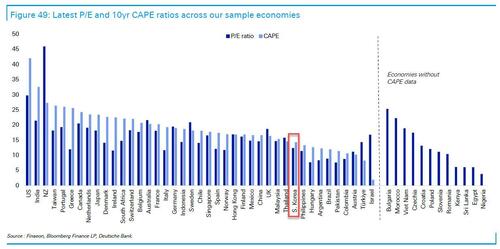
- "Korea discount" compression. Long-debated corporate governance reforms are starting to look more credible, and markets are rewarding the prospect of better capital allocation, higher shareholder returns, and fewer value-destroying cross-holdings. Even small shifts here can have a big impact when a market has traded on a persistent valuation discount for decades. Curiously, last October, in his Ultimate Guide to Long-Term Investing, Reid showed that South Korea sat in the bottom third of global equity markets by valuation in a report built around the idea that valuations dominate long-run returns. Valuation as an investment theme is quite clearly back.
- Macro tailwinds. Growth optics have improved alongside a steadier policy backdrop: today saw the Bank of Korea upgrade their growth forecasts and signal they don’t expect to change policy over the next 6 months, keeping conditions especially loose despite soaring housing prices. Deutsche Bank's Juliana Lee has been more positive than consensus on Korea’s economy of late. See her latest here: Korea Macro Insight: Tailwind for Growth and Hawks

However, if we stick to the valuation portfolio from the DB long-term study, South Korea’s recent surge would move it from the “cheap” basket into the “expensive” one when ranking global equity markets by valuation.
As Reid warns, "Over the long run, valuation wins out handsomely, so this shift is worth bearing in mind." Of course, the long-run won't t matter, and the moment memory prices reverse lower, Samsung and Hynix will crash, bursting the Korean stock bubble and forcing the BOK to launch a bailout of the stock market or else suffer a painful recession.
For those wondering when that may be, we will try to give an 3answer in a follow up post.
More in the full DB notes (here and here) available to pro subs.