
Continues here


Hormuz Echoes the 1956 Suez Canal Crisis
Geography as Leverage: The Power of Narrow Passages
Authored by GoldFix
The comparison between the current Gulf tensions involving Iran and the Suez Crisis of 1956 rests on three structural pillars:
- control of maritime chokepoints,
- the entanglement of regional conflict with global power competition,
- and the signaling of hegemonic limits.
- Each shaped the Suez episode; each is now re-emerging in altered form.
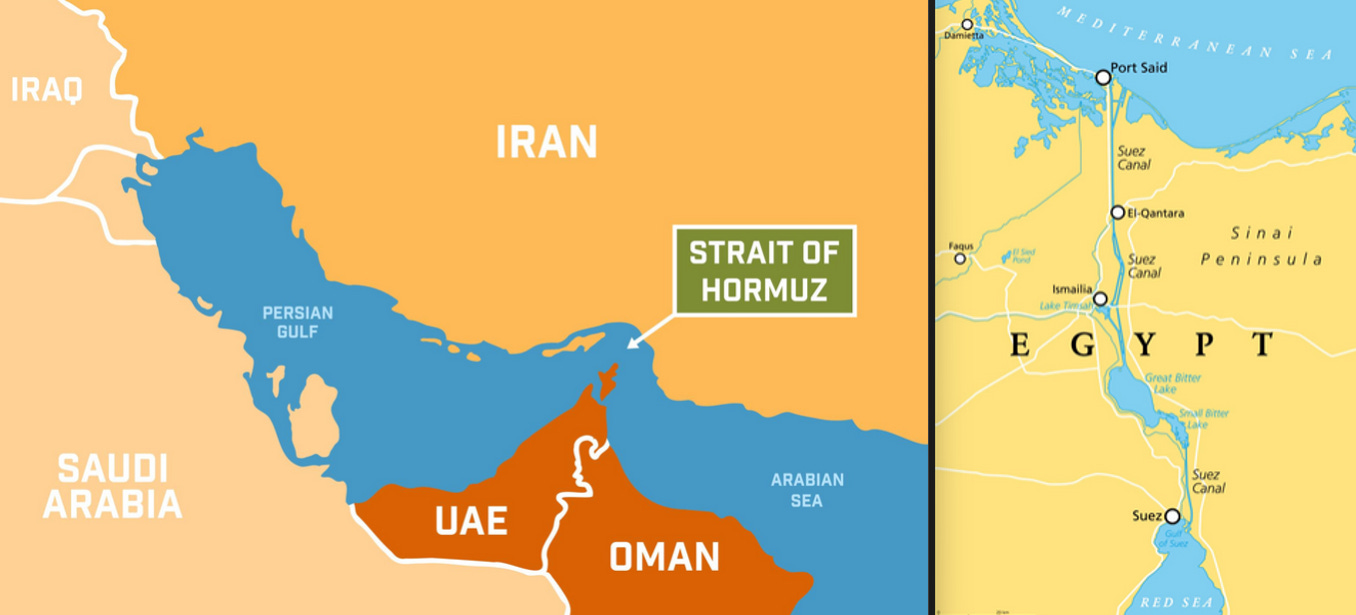
In 1956, the Suez Canal was an indispensable artery for European energy. Its nationalization transformed a commercial route into a geopolitical lever, exposing how dependent industrial economies were on a single corridor. The issue was not just volume, but irreplaceability.
Today, the Strait of Hormuz serves a similar role. A meaningful share of global oil flows through it. As with Suez, the risk is not closure, but credible disruption. Even marginal interference, military signaling, insurance repricing, shifts the cost of energy and the pricing of risk across markets.
From Regional Conflict to Systemic Risk
Suez began as a regional dispute and quickly became a global event. The United States and the Soviet Union were pulled in, not by choice, but by consequence. The critical moment came when the United States forced Britain and France to withdraw, demonstrating that legacy powers could not act independently at system-critical nodes.
The Gulf shows a similar layering. Iran is the regional actor, but the implications extend outward. The United States remains the primary security presence, while China and Europe depend on uninterrupted energy flows. This creates a structure where local escalation carries global consequences.
“The canal is ours… and we shall defend it to the last drop of our blood.”
— Gamal Abdel Nasser, 1956
The statement reflects a broader truth. Control over infrastructure confers leverage beyond borders. Iran’s proximity to Hormuz provides a comparable, if indirect, form of influence.
Hegemon Constraint and Lessons from Suez Limits
Suez marked the limits of British and French power. Their failure was not military, but structural. Without U.S. financial and diplomatic backing, their position collapsed. Control of the canal proved conditional.
The Gulf raises a parallel question. The United States continues to guarantee maritime security, but that role may no longer be fully unilateral in practice. Securing Hormuz at scale may require participation, or at least alignment, from other major stakeholders.
The Missing Layer: Who Backs the Backstop?
In 1956, Britain and France assumed control could be maintained through force. The outcome showed that enforcement depended on a higher-order backer.
Today, the same question applies to the United States. If the burden of securing Hormuz rises, who supports that effort?
China has direct exposure as a major importer of Gulf energy. European powers, including France, retain capability and economic interest. Others benefit from the flow without contributing to its security. What remains unclear is whether dependence converts into participation.
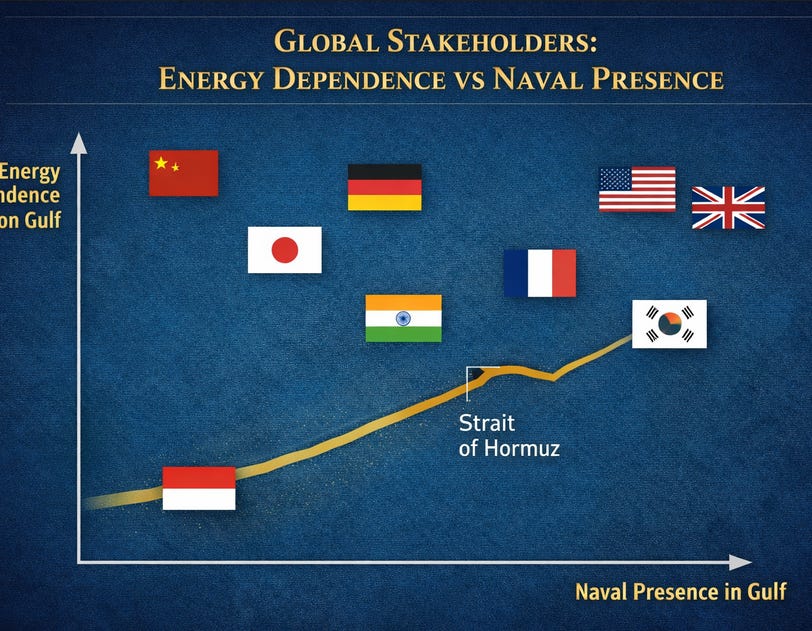
If support materializes, the system shifts toward shared enforcement. If it does not, the burden concentrates, and the fragility increases. In either case, control becomes conditional.
Free Posts To Your Mailbox
Contributor posts published on Zero Hedge do not necessarily represent the views and opinions of Zero Hedge, and are not selected, edited or screened by Zero Hedge editors.
Loading...