

Continues here


Jeff Currie: The Global Economy is in for a (C)rude Awakening
The Hormuz disruption exposes a system-wide commodity constraint where oil’s irreplaceability drives production risk, not demand adjustment. Physical shortages are amplified by global hoarding, creating a behavioral demand surge. Policy tools are insufficient, credit transmission is tightening, and markets are shifting toward a security-driven regime favoring commodities and asset-heavy sectors.
Jeff Currie of Carlyle comes to a similar conclusion as Bernstein did in Oil Could Hit $170 Peak if This lasts 6 Months in that this is about duration of logistic disruption as opposed to availability of SPR Oil.
TL;DR
- Hormuz closure creates a system-wide commodity shock: The disruption is system-breaking, not just oil-specific
- Oil is structurally irreplaceable, amplifying risk
- Hoarding amplifies the crisis
- Regime shift toward energy security away from J.I.T. stockpiles
- Deglobalization, reversed petrodollar recycling, and underweight energy exposure in portfolios point toward structurally higher commodity prices and a rotation into “old economy” assets as the system reprices energy security risk
The closest they get to a price target is this:
- Embedded security premium in all flows (aka backwardation)
- Implied outcome: persistent upward bias, not a spike-and-revert
- Emphasizes higher highs and higher lows, not a fixed endpoint
- Very similar logic to the Bernstein report without putting a price on it… SPR prevents spikes, turning an acute problem into a prolonged chronic crisis.
The Shock Is Physical, The Crisis Is Systemic
Authored by GoldFix
The closure of the Strait of Hormuz is framed as a geopolitical disruption, but the report treats it as a system-wide constraint across the global commodity complex. The removal of flows through a single chokepoint simultaneously impacts oil, liquefied natural gas, fertilizers, and industrial metals, creating a layered supply shock that exceeds the capacity of policy responses to offset. The scale of disruption, measured in hundreds of millions of barrels equivalent, challenges the assumption that markets can clear through price alone.

This framework is developed in A Crude Awakening by Carlyle’s commodity strategists, who argue that markets are underestimating both the duration and structural implications of the outage. Their central contention is that financial pricing continues to reflect a temporary dislocation, while the physical system is experiencing a binding constraint.
“The system simply cannot accommodate that kind of disruption… either the probability is wrong, or markets are wildly optimistic.”
Oil’s Role Has Narrowed and Strengthened Simultaneously
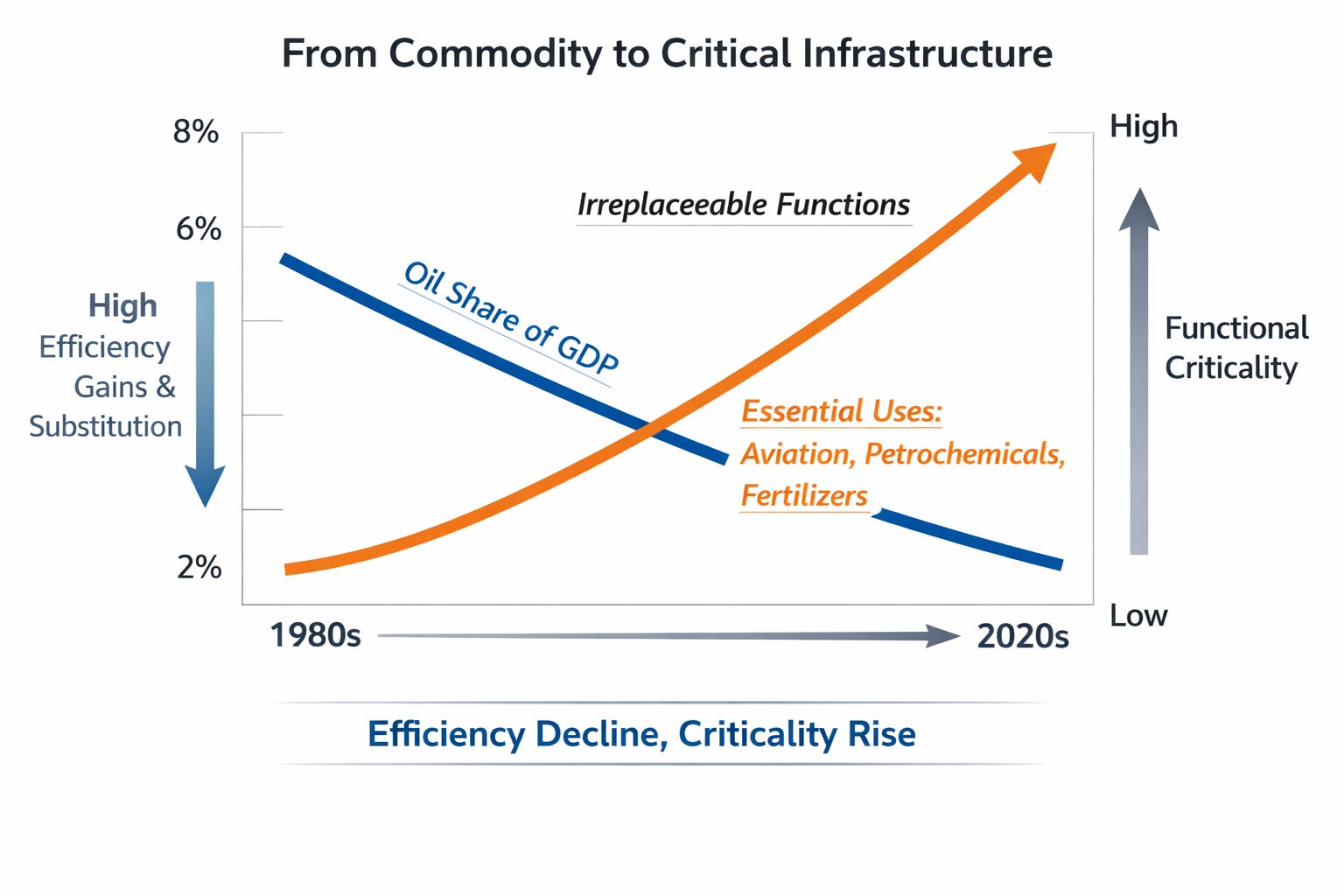
The report reframes oil’s position in the global economy by separating its declining share from its rising functional importance. Over decades, substitution and efficiency gains reduced oil intensity per unit of GDP. However, that process eliminated the marginal uses first, concentrating demand in applications that lack viable alternatives.
These residual uses include aviation fuel, petrochemical feedstocks, fertilizer production, and grid balancing. The implication is structural. When supply is disrupted, adjustment does not occur through reduced consumption; it occurs through halted production in dependent sectors. Oil therefore behaves less like a cyclical commodity and more like a critical input embedded in multiple industrial chains.
“Remove them and you do not get demand destruction; you get production shutdowns.”
The Security Premium Is Behavioral, Not Just Physical
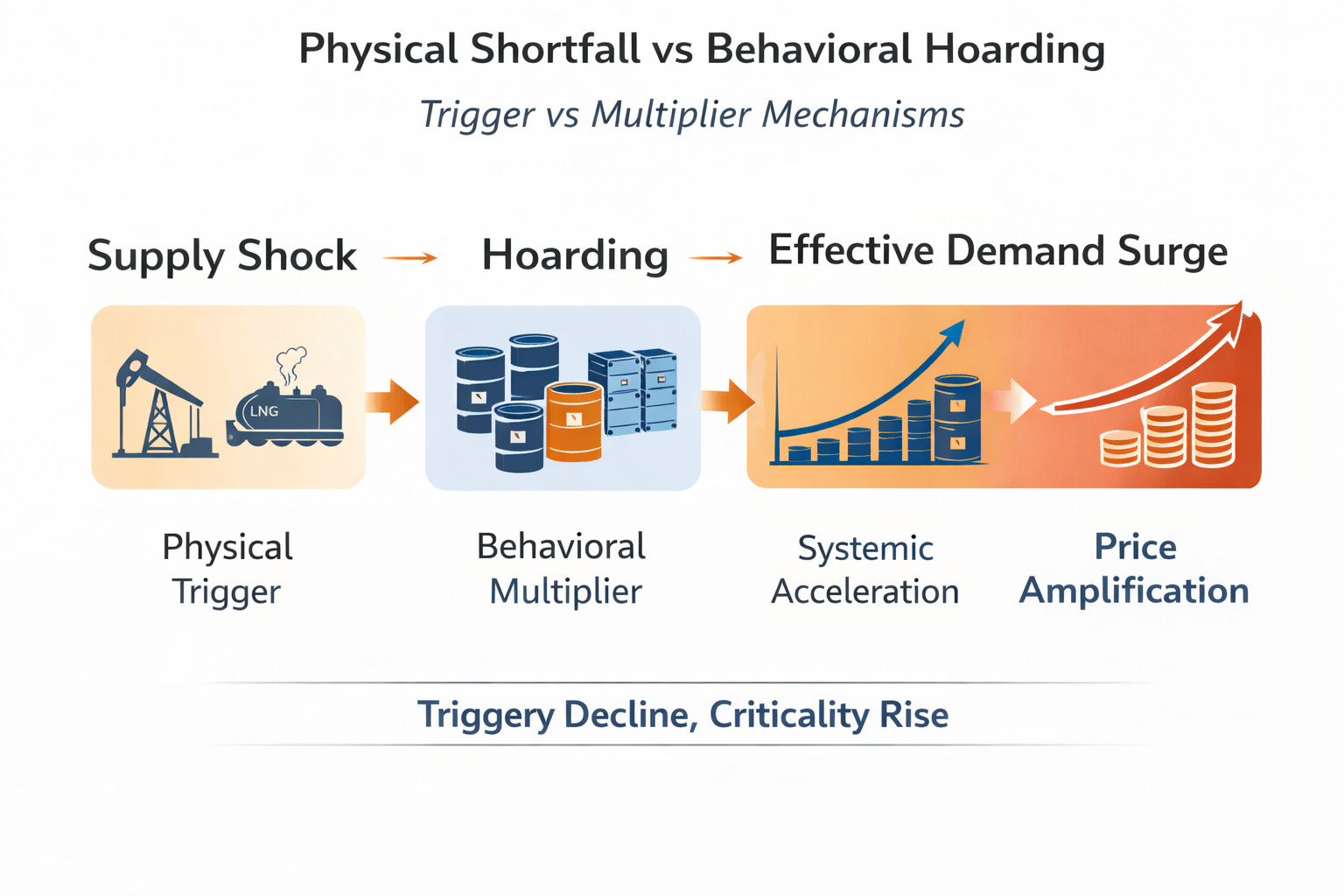
The report identifies a second-order amplification mechanism driven by behavior. Physical shortages initiate the disruption, but precautionary hoarding expands it. Historical precedent from the late 1970s shows that relatively small supply losses can produce disproportionately large price movements once inventory accumulation begins.
The current environment is characterized by synchronized action across major importing nations. Export restrictions, reserve accumulation, and supply preemption generate additional demand that exists independently of consumption. This transforms the event from a supply shock into a system-wide scramble for availability.
“The physical shortfall is the trigger; the behavioral response is the multiplier.”
From Energy Shock to Commodity System Cascade
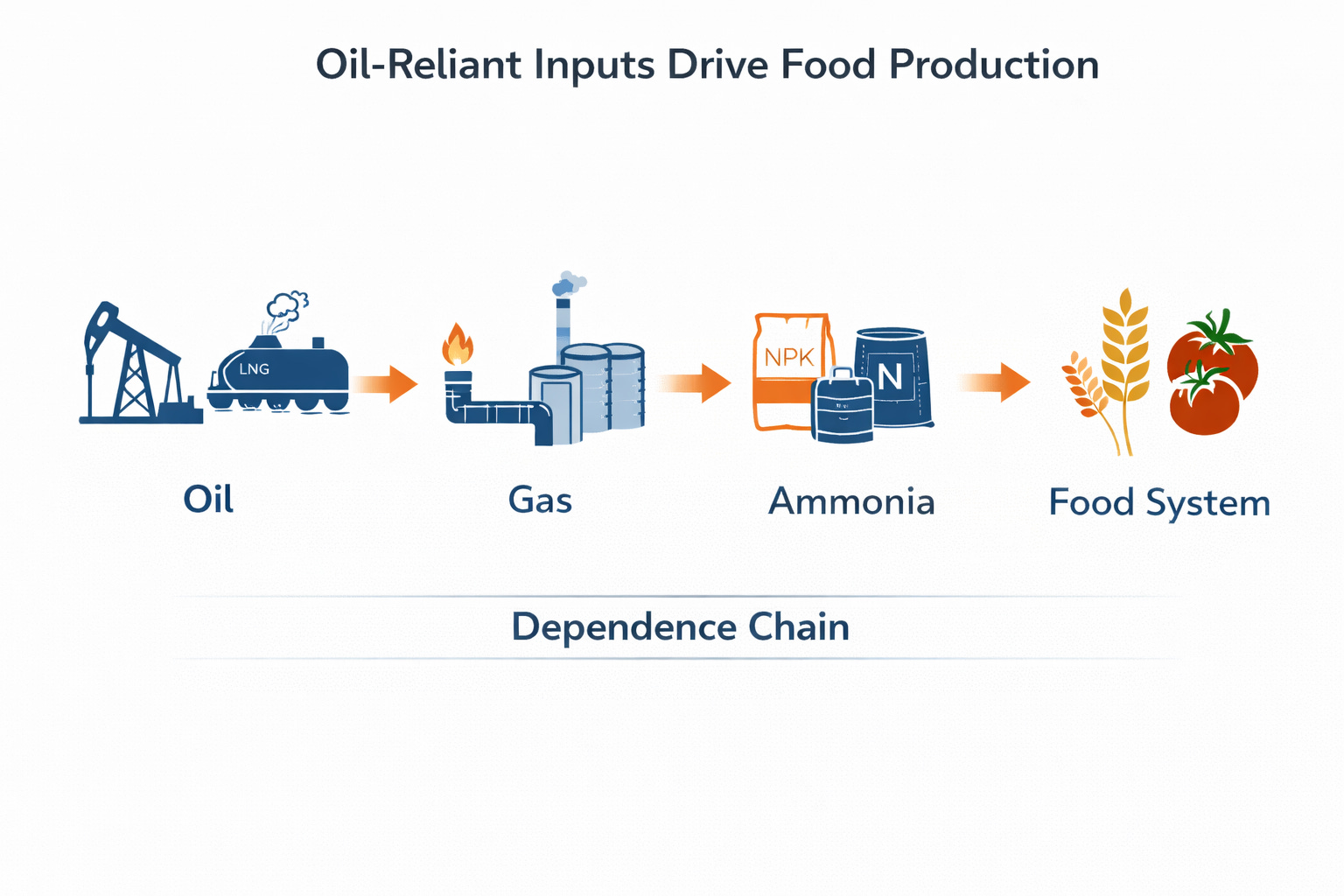
The disruption is not isolated within energy markets. The report details a cascading chain across commodities, where oil and gas inputs feed directly into fertilizer production, industrial processes, and ultimately food systems. The closure of Hormuz interrupts these linkages simultaneously, producing compounding second-order effects.
This cascade operates through physical dependency chains rather than price signals. Gas feeds ammonia, ammonia feeds urea, and urea underpins agricultural output. Similar linkages extend into petrochemicals and industrial metals, reinforcing the systemic nature of the disruption.
Energy Security Has Reordered the Transition Framework
The report introduces a hierarchy of energy priorities: security, affordability, then sustainability. This ordering reframes the energy transition as a response to geopolitical vulnerability rather than environmental objectives. The system is described as being mid-transition, with legacy hydrocarbon infrastructure partially dismantled while replacement capacity remains incomplete.
This creates a structural condition where energy insecurity rises during the transition phase. In response, states and firms shift from optimization toward accumulation. Investment in domestic energy capacity, diversification of supply, and stockpiling behavior become rational responses to uncertainty.
China is presented as a case study of this approach, accelerating efforts to secure domestic energy inputs as a foundation for industrial and technological expansion.
The Credit Channel Has Reversed
A key distinction from historical oil shocks lies in the financial transmission mechanism. In the 1970s, rising oil revenues were recycled through Western financial systems, expanding liquidity and offsetting some of the contractionary effects of higher prices.
In the current environment, that mechanism operates in reverse. Capital is retained domestically within producing regions, while broader trends toward deglobalization reduce the recycling of surpluses into global credit markets. At the same time, higher sovereign debt levels and inflation-linked fiscal dynamics increase borrowing requirements, tightening financial conditions.
Oil Could Hit $170 Peak if This lasts 6 Months

Bottom Line: SPR Releases do not prevent price spikes, they delay them. Logistics bottlenecks are what drives price ultimately now. Duration of logistics (flow) crisis, not supply (stock) overhang, is key.
Models Price Scarcity, Not Physical Absence
The report challenges the applicability of standard macroeconomic models of commodity shocks. Traditional frameworks assume that supply remains available at higher prices, allowing markets to clear through price adjustments. The current disruption differs in that it removes access to supply entirely.
Free Posts To Your Mailbox
Contributor posts published on Zero Hedge do not necessarily represent the views and opinions of Zero Hedge, and are not selected, edited or screened by Zero Hedge editors.
Loading...